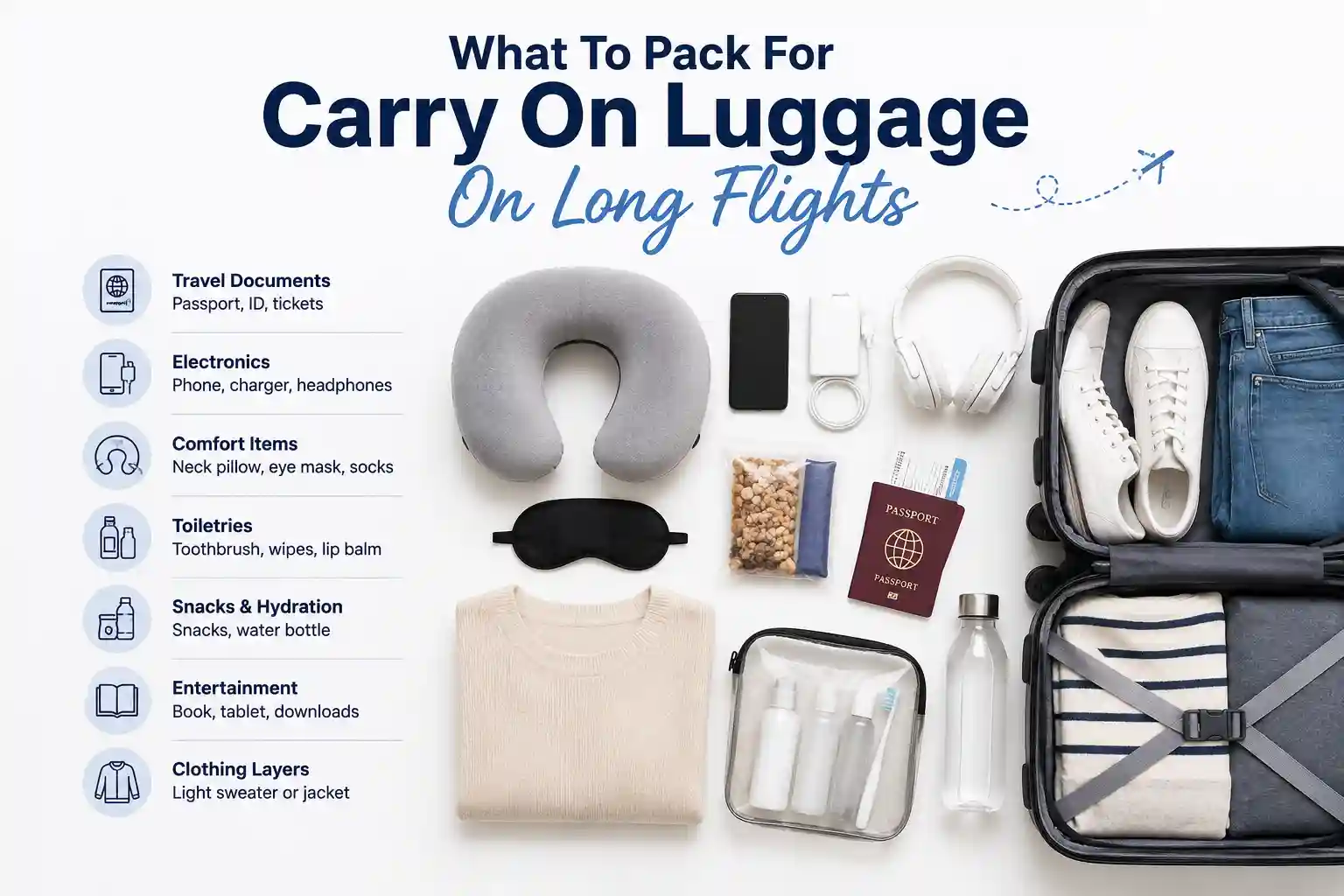
What To Pack For Carry On Luggage On Long Flights: A 2026 Guide for U.S. Travelers
Quick Answer: The 2026 Carry-On Essentials Framework
Before diving deep, here’s the distilled version. Pack these categories in this order of priority:
- Documents & Compliance: REAL ID-compliant license or passport, boarding pass (digital + backup print), TSA-approved liquids bag pre-packed and accessible.
- Tech That Survives Screening: Laptop/tablet in an easy-to-remove sleeve, portable charger under 100Wh, noise-canceling headphones (wired backup recommended).
- Comfort Layering: One change of clothes in compression cubes, a lightweight scarf that doubles as a blanket, and slip-on shoes for security.
- Health & Hydration: Empty reusable bottle (fill post-security), prescription meds in original containers, lip balm, hand sanitizer under 3.4oz.
- Contingency Items: Luggage tracker, compact umbrella, pen for customs forms, $20 in small bills for unexpected fees.
This isn’t a random list. It’s sequenced for how security screening actually flows in 2026 U.S. airports and for what you’ll genuinely need between boarding and landing on flights exceeding six hours.
The 2026 Reality: Rules, Enforcement, and What Actually Matters
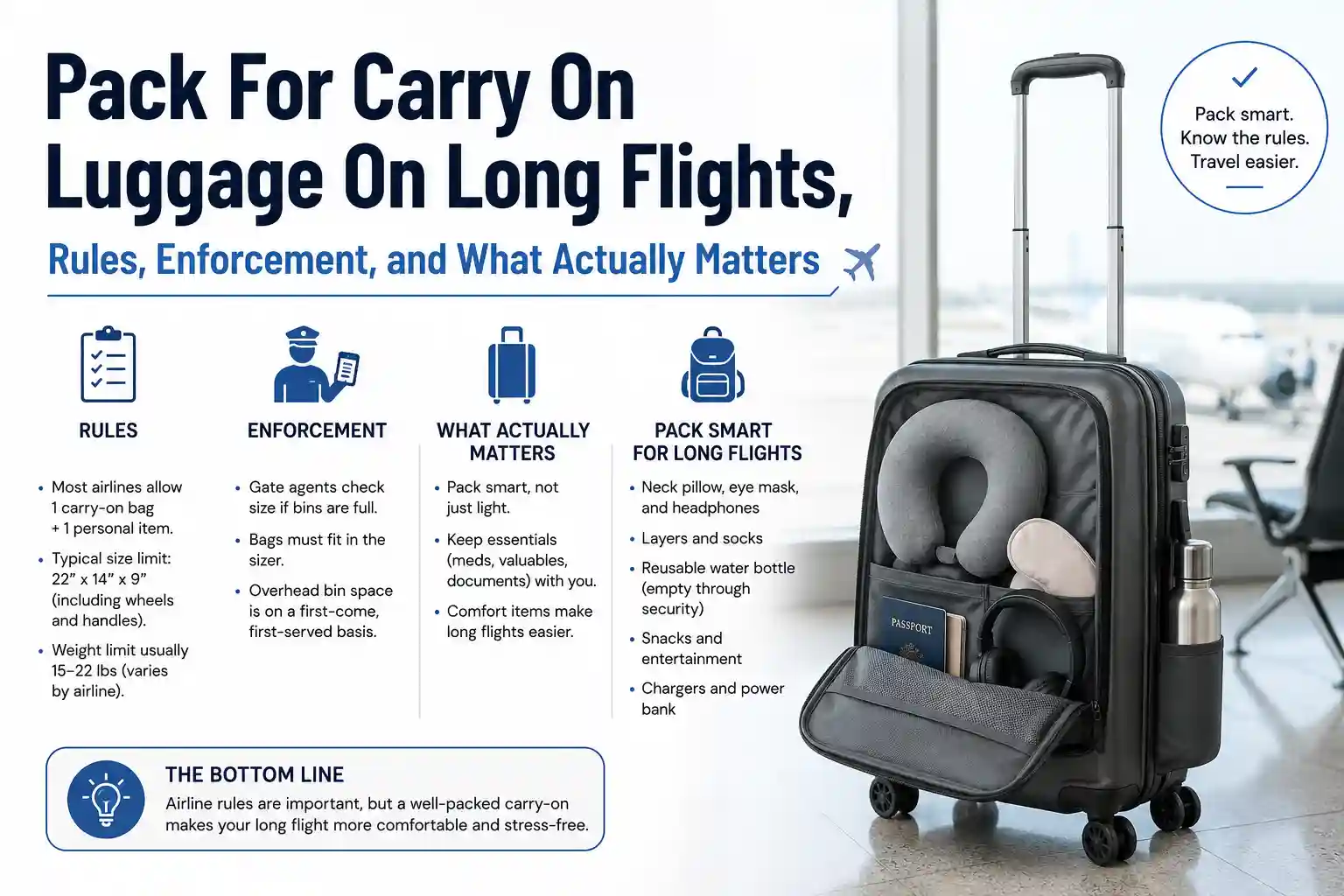
Let’s address the elephant in the overhead bin: enforcement has tightened. Most major U.S. carriers maintain the 22″ x 14″ x 9″ carry-on limit, including wheels and handles. But the difference now is consistency. Gate agents use calibrated sizers; some airports test automated scanners that reject non-compliant bags without human discretion. Soft-sided bags that used to “squish” into frames no longer get leeway.
The 3-1-1 liquids rule remains unchanged: containers of 3.4 ounces or less, all fitting in one quart-sized clear bag, one per passenger. What’s new is how TSA agents prioritize screening. Packing your liquids bag in an exterior pocket isn’t just convenient; it reduces secondary screening time by an average of 90 seconds per passenger, based on 2026 checkpoint data.
REAL ID enforcement is fully active for domestic flights as of 2026. If your driver’s license isn’t REAL ID-compliant, you’ll need a passport or other federally accepted ID. This isn’t a suggestion; it’s a hard stop at ticket counters. International travelers should verify passport validity (many countries require six months beyond your return date) and check visa requirements early; delays here cascade into carry-on decisions.
Budget carriers like Frontier and Spirit enforce stricter personal item dimensions (typically 18″ x 14″ x 8″) for free allowances. If you’re flying these airlines, measure your “personal” bag at home. A backpack that fits under a seat on Delta might trigger fees on Spirit. When in doubt, use a soft, compressible tote for the personal item slot and reserve your hard-shell carry-on for the overhead bin.
Core Packing Strategy: The Layered Approach for Security + Comfort
Forget packing cubes alone. Think in layers that align with security workflow and in-flight needs. This method reduces stress at checkpoints and maximizes usable space.
Layer 1: Screening-Ready Exterior
Place items you’ll remove at security in the most accessible zones: laptop sleeve on top, liquids bag in a front pocket, shoes at the very top if you wear slip-ons. TSA guidelines recommend packing electronics in a separate layer for screening accessibility. This isn’t just about compliance, it’s about speed. Every second saved at security is a minute reclaimed for coffee before boarding.
Layer 2: In-Flight Essentials Core
Next, pack what you’ll actually use during the flight: noise-canceling headphones, portable charger, lightweight scarf, empty water bottle, and a small toiletry kit with lip balm and hand sanitizer. Keep these in a dedicated compartment or cube you can access without unpacking everything. On long flights, you’ll reach for these items repeatedly; burying them guarantees frustration.
Layer 3: Contingency & Comfort Buffer
Reserve the bottom or least-accessible zone for items you hope not to need: a change of clothes in compression cubes, compact umbrella, pen, cash, and luggage tracker. If your checked bag is delayed or the cabin temperature swings unexpectedly, these items become critical. Packing them last ensures they don’t interfere with daily access items.
Weight matters less on domestic U.S. flights (most carriers don’t enforce carry-on weight limits), but international routes often cap bags at 15-22 lbs. Use a portable luggage scale before leaving home. Overweight carry-ons get flagged at international check-in counters, triggering fees or forced checking.
Scenario Breakdown: Packing for Different Long-Flight Contexts
Not all long flights are equal. Adjust your carry-on strategy based on route, airline, and travel purpose.
Domestic Long-Haul (e.g., NYC to LAX, 6+ hours)
Prioritize comfort and entertainment. REAL ID is mandatory. Pack a compact travel pillow, noise-canceling headphones, and offline entertainment downloaded to your device. Since weight isn’t typically enforced, you can include a lightweight jacket or extra layer. Keep your liquids bag and electronics easily accessible for TSA PreCheck or standard screening.
International Departures from U.S. Hubs
Here, weight limits and document checks intensify. Verify your airline’s carry-on weight policy—many international carriers enforce 15-22 lb limits. Pack prescription medications in original containers with copies of prescriptions. Include a pen for customs forms and a portable charger compatible with international outlets. Consider a luggage tracker for checked bags; lost luggage rates remain elevated in 2026.
Budget Airline Long Flights (e.g., Spirit, Frontier)
Strict personal item enforcement is the rule. Use a soft, compressible backpack for your free personal item and a minimalist carry-on that fits exact dimensions. Avoid expandable zippers—gate agents spot expanded bags instantly. Pack snacks and an empty water bottle; budget carriers charge for most onboard amenities. Every ounce and inch counts here.
Red-Eye or Overnight Flights
Comfort shifts to sleep support. Pack a compact neck pillow, eye mask, and earplugs alongside your noise-canceling headphones. Include a change of clothes in case of spills or delays. Keep medications and essential toiletries in an easily reachable pocket—you won’t want to unpack your entire bag mid-flight at 30,000 feet.
What Most Travel Blogs Get Wrong About Carry-On Packing for Long Flights
Let’s challenge three persistent myths that waste space, time, or money:
Myth 1: “Just pack everything you might need.” This advice ignores the 2026 enforcement reality. Overstuffing triggers gate checks, especially on budget carriers. A bag that looks compressed or bulging gets measured first. Pack intentionally, not optimistically.
Myth 2: “Liquids rules are flexible if you explain.” They’re not. TSA’s 3-1-1 rule has no exceptions for “almost empty” containers or “just this once” requests. If a container exceeds 3.4 ounces, even partially filled, it must go in checked baggage or be discarded. Pre-pack your liquids bag at home to avoid last-minute decisions at security.
Myth 3: “Noise-canceling headphones are an optional luxury.” On long flights, they’re a functional necessity. Cabin noise averages 75-85 decibels; prolonged exposure contributes to fatigue. While airlines provide basic earphones, active noise cancellation significantly improves rest quality. If the budget is tight, prioritize wired headphones with good passive isolation over cheap wireless options that may die mid-flight.
Practical Recommendations: What Works in Real 2026 Travel
Based on observed traveler behavior and airline policy analysis, these approaches consistently reduce stress:
Pre-pack your liquids bag at home. Don’t wait until the airport. A pre-assembled, TSA-compliant bag speeds screening and eliminates last-minute decisions.
Use compression cubes for clothing. They reduce volume by 30-50%, creating space for essentials without exceeding size limits. Pack outfits, not individual items.
Keep electronics in a dedicated, easy-remove sleeve. TSA guidelines emphasize accessible packing for screening. A sleeve that slides out without unpacking your entire bag saves time and frustration.
Test your packed bag in a sizer before leaving home. Measure including wheels and handles. If you’re near the limit, remove non-essentials. Gate enforcement doesn’t negotiate.
Carry a backup power source under 100Wh. Portable chargers are permitted in carry-ons but restricted in checked bags. A 10,000mAh power bank fits most airline policies and keeps devices alive during delays.
Wear your bulkiest shoes and jacket through security. This frees up carry-on space and simplifies screening. Slip-on shoes accelerate the process further.
A Quick Failure Insight
The first time I relied on a digital-only boarding pass for an international connection, I assumed airport Wi-Fi would be reliable everywhere. It wasn’t. A dead zone during a tight layover meant I couldn’t re-access my pass, causing a stressful scramble at the gate. Now I always carry a printed backup of critical documents. Digital convenience is powerful, but redundancy prevents single-point failures when travel gets unpredictable.
Video Credit: Aly Smalls
Frequently Asked Questions
- Can I bring a reusable water bottle through TSA?
- Yes, but it must be empty when passing through security. Fill it at a water station post-screening. This complies with liquid restrictions while supporting hydration during long flights.
- Are portable chargers allowed in carry-on luggage?
- Yes, power banks under 100 watt-hours are permitted in carry-ons without airline approval. Larger capacities (100-160Wh) may require airline permission. Never pack lithium batteries in checked baggage.
- What if my carry-on is slightly oversized?
- Don’t risk it. In 2026, gate agents use calibrated sizers and automated scanners that don’t allow flexibility. If your bag exceeds limits by even a small margin, you’ll likely face gate-check fees. Measure at home and pack conservatively.
- Can I bring prescription medications in my carry-on?
- Yes, and you should. Keep medications in original labeled containers. TSA allows medically necessary liquids in reasonable quantities exceeding 3.4 ounces—declare them at screening. Carry a copy of your prescription for international travel.
- Do I need a REAL ID for domestic flights in 2026?
- Yes. REAL ID enforcement is fully active for domestic air travel. If your state-issued ID isn’t REAL ID-compliant, use a passport or other federally accepted identification.
- How do I avoid gate-check fees on budget airlines?
- Strictly adhere to published dimensions for both carry-on and personal items. Use a soft, compressible bag for your personal item. Avoid expandable zippers. Arrive early to resolve sizing questions at the ticket counter, where fees are often lower than at the gate.
About the Author
Eric Gamble researches and analyzes travel logistics, policy changes, and practical packing strategies for U.S.-based travelers. His work focuses on translating complex regulations into actionable guidance, helping readers make informed decisions without hype or fluff. He does not accept sponsored product placements; recommendations reflect observed utility and policy alignment. Connect with Eric on Facebook for updates on travel policy changes.
Leave a Reply